

It’s 7:40 a.m. Your car is behind the door, the clicker is in your hand, and nothing is happening. If your garage door won’t open, you’re not dealing with some rare mechanical mystery. You’re dealing with one of about seven common problems. A few of them you can fix yourself in under two minutes. A few of them can send you to the emergency room if you try.
This guide walks you through both kinds, in the order you should check them. By the end, you’ll know whether you’re two minutes from a fixed door or one phone call from a safe repair.
The 30-Second Checks Before You Call Anyone
Start with the easy stuff. Roughly a third of “broken” garage doors aren’t broken at all.
Cause 1: The Wall Button Is in Lock Mode
Most modern openers have a lock or vacation setting on the wall console. Kids press it. Elbows press it. When it’s on, your remotes stop working but the wall button still runs the door. Hold the lock button for a few seconds to toggle it off, then try your remote again.
Cause 2: Dead Batteries or Tripped Power
Check the remote battery first, then the opener itself. Look up: is the motor unit’s light on? If not, check the outlet and your breaker panel. A garage circuit trips more often than people expect, since freezers, shop tools, and openers often share it.
You Can Hear the Motor, But the Door Isn’t Moving
This is the call we get more than any other. A customer in Stone Mountain put it perfectly: “When you press it, you can hear the motor, but it’s not moving.”
That sound tells us two things. Power is fine. The connection between the motor and the door is not.
Cause 3: The Trolley Is Disconnected or the Gear Is Stripped
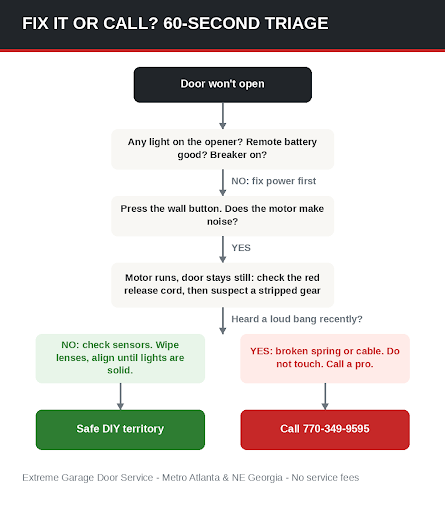
Every opener has an emergency release, the red cord hanging from the rail. If someone pulled it, the motor runs but the door stays put. Re-engaging it is usually simple: pull the cord toward the door and run the opener until it clicks back in.
If the trolley is engaged and you hear grinding, the main drive gear inside the motor has likely stripped. That’s a repair-or-replace decision. On an opener over 10 years old, replacement usually wins the math. Extreme Garage Doors installs a ¾ HP Genie opener with two remotes and a keypad for $589, often less than chasing parts for a discontinued unit.
 Field Note: The fastest way to get an accurate answer is a photo. Text a picture of your door, opener, or the part that looks wrong to 770-349-9595. We can usually tell you what you’re dealing with, and what it’ll run, before a truck ever rolls.
Blinking Lights and a Door That Won’t Cooperate
Cause 4: Misaligned or Blocked Safety Sensors
Those little eyes near the floor on each side of the door do exactly one job: refuse to let the door close on something. When they’re blocked, bumped, or coated in cobwebs, they get stubborn.
A rake handle, a lawn chair, even bright sunlight hitting one lens can do it. Wipe both lenses, check that each has a solid indicator light, and gently adjust until the lights stop blinking. One Dawsonville homeowner installed two openers himself. One worked fine; the other “thought something was blocking the sensors” for days. It was an alignment issue we sorted in a single visit.
Sensors are a safe DIY fix. The next three causes are not.
The Loud Bang: A Broken Spring
Cause 5: Torsion Spring Failure
If you heard something like a gunshot from the garage recently, this is almost certainly your answer. A caller in Oakwood described it exactly: the torsion spring over the door snapped in the morning, and a cable let go with it.
Springs do the actual lifting; the opener just guides the door. A standard double door weighs 150 to 250 pounds, and when the spring breaks, all of that weight is suddenly real. The door won’t open and forcing it is how openers burn out and backs get wrecked.
Here’s the line we don’t want you to cross do not unbolt, adjust, or “unwind” a torsion spring yourself. Those springs hold enormous stored tension and require winding bars and experience to handle safely.
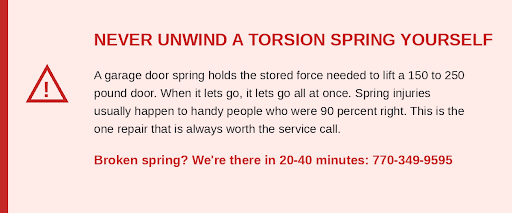
Plain Truth: Search results are full of DIY spring videos, and every garage door tech has met the aftermath. In our experience, spring injuries don’t happen to careless people. They happen to handy people who were 90 percent right, and the last 10 percent is the part that bites. This one repair is genuinely worth the service call.
Snapped Cables and Doors Off Their Track
Cause 6: Frayed or snapped lift cables. Cables and springs work as a team, and cables often fail right after a spring does. A door hanging crooked, or one visible cable coiled loosely at the side, means stop. The remaining cable is carrying a load it wasn’t built for.
Cause 7: The door has jumped its track. Rollers pop out after an impact: a bumper tap, a basketball, a warped panel. An off-track door might still move a few inches, which tempts people to muscle it. Don’t. A door that comes fully out of its track can fall, and it won’t fall slowly.
Both of these share DNA with spring failure: heavy things under tension, held by parts that have already failed once. This is exactly the situation where a fast, professional repair costs far less than the damage a second failure causes, to the door or to you.
When to Stop and Call a Professional
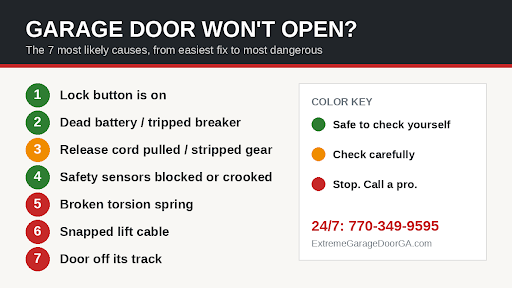
Quick triage, all seven causes in one place:
- Fix it yourself: lock button, batteries, tripped breaker, blocked or crooked sensors, re-engaging the release cord.
- Call a pro: stripped opener gears, broken springs, snapped cables, off-track doors. Anything involving the parts that lift or hold the door’s weight.
Extreme Garage Doors has spent 29 years doing one thing well across Metro Atlanta and Northeast Georgia: getting broken doors moving again, usually the same day. Family-owned since 1997, no service fees, and trucks stocked to finish most repairs on the first visit. That’s why homeowners from Gainesville to Dawsonville call Brad directly when the door won’t budge. If you’re not sure whether your town is in our service area, call anyway; we probably cover you. And if you’re weighing a cheap fix against doing it right, we’ve written about why the bargain repair often costs double.
An Open-and-Shut Case
Most stuck doors come down to this: if it’s electronics, try the simple checks. If it’s anything carrying the door’s weight, put the ladder away. Knowing the difference saves you money on the easy stuff and protects you from the dangerous stuff. Door still won’t open? Call or text 770-349-9595. We answer 24/7, and we’re usually there in 20 to 40 minutes.
FAQs
What’s the best thing to do when your garage door won’t open?
Start with the two-minute checks: remote battery, breaker, the lock button on the wall console, and the safety sensor lights. If the motor runs but the door doesn’t move, or you heard a loud bang recently, stop there and call a professional. Those symptoms point to springs, cables, or gears, which aren’t safe DIY repairs.
Can I open my garage door manually if the opener is dead?
Yes, if the springs are intact. Pull the red emergency release cord and lift the door by hand; a healthy door should rise with moderate effort and stay open on its own. If it feels extremely heavy or slams back down, a spring has failed. Don’t force it. That weight is the danger, not the opener.