

 You changed your own brake pads once. You’ve wired a ceiling fan. So when the garage door spring snapped, your first move was the same as everyone’s: you searched for how to replace a garage door spring, and a twelve-minute video made it look like a Saturday morning job.
Here’s what that video didn’t show you. Garage door techs, ER staff, and insurance adjusters all agree on this one: spring replacement is the single most dangerous do-it-yourself job in a typical house. Not the roof. Not the electrical panel. The spring.
This post explains why, in plain terms, and what the smarter play looks like.
What a Torsion Spring Actually Does
Your opener doesn’t lift your garage door. It never has. The spring does the lifting; the opener just steers.
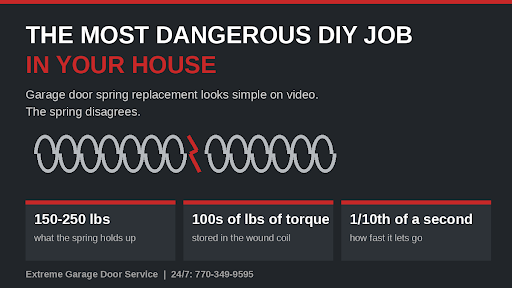
A standard double door weighs 150 to 250 pounds. To move that weight with a small electric motor, the torsion spring above the door stores hundreds of pounds of twisting force in its coil, wound tight like a crossbow that stays cocked for years. Every time the door goes up, the spring releases a little of that force. Every time it comes down, the door winds it back in.
The Numbers That Should Give You Pause
- A wound residential torsion spring stores enough energy to lift a refrigerator.
- When a spring slips or breaks during handling, it releases that energy in a fraction of a second.
- The parts nearest your hands (winding cone, set screws, bars) are exactly where the force concentrates.
How Spring DIY Goes Wrong
The injuries aren’t from the spring flying across the garage like a movie prop. They’re closer and quicker than that.
The Screwdriver Problem
Torsion springs are wound and unwound with solid steel winding bars seated fully in the cone. The classic DIY mistake is substituting a screwdriver or a piece of rebar. Under load, a screwdriver flexes, slips out of the cone, and the cone spins with everything the spring has. Hands, wrists, and faces are in the arc.
The Wrong Spring Problem
Springs are matched to the door’s exact weight and height, by wire size, diameter, and length. Order the wrong one online and the door becomes a 200-pound guessing game: too weak and the opener strains and fails early; too strong and the door wants to fly up. In our repair calls across Metro Atlanta, mismatched DIY springs are one of the most common things we end up correcting.
And a detail most first-timers miss: springs almost always fail in pairs. If one side broke, its twin has the same mileage on it. That’s why we price it the way we do; right now when you replace one spring, the second is half off.
Job Site Reality: Every tech has met the aftermath of a spring video. The pattern is always the same: it isn’t careless people who get hurt. It’s capable, handy people who did nine steps right and misjudged the tenth. With most DIY projects the tenth step costs you a redo. With a wound spring it can cost you a hand.
But the Video Made It Look Easy
It always does. The person in the video has replaced a thousand springs. They know how a cone feels right before it slips, which set screws are stripped, and when a ladder is about to walk. None of that experience transfers through a screen.
There’s also a selection effect nobody mentions: people don’t upload the attempt that went wrong. You’re watching the survivors.
What It Costs to Do It Right
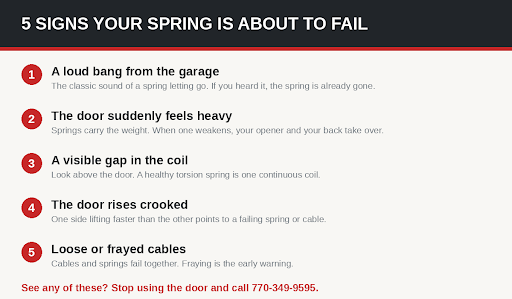
Here’s the honest math. DIY means buying springs online and hoping the size is right, buying winding bars you’ll use once, and spending an afternoon on a ladder under tension. Professional replacement at Extreme Garage Doors is priced by the job, with no service fee and no hourly meter running. You get the correct spring matched to your door’s weight, both sides done in about an hour, and someone to call if anything ever feels off.
A caller from Oakwood put the real timeline in perspective recently: his spring snapped in the morning, and by texting us a photo of the door he had an answer before lunch. That photo trick works for anyone. It’s the fastest quote we can give.
Tech’s Checklist: Want to be useful to your door without touching a spring? Twice a year: lubricate the rollers, hinges, and spring coil with garage door lube (not WD-40), test the safety sensors with a cardboard box, and pull the red release cord with the door DOWN to check the door’s balance. A balanced door stays put at waist height. If it slams or rockets up, the spring is wrong. Call us.
The DIY Jobs That Are Actually Worth Your Saturday
We’re not anti-DIY. Plenty of garage door care is safe and satisfying: swapping remote batteries, wiping and aligning the safety sensors, tightening hinge bolts, replacing weather stripping, and the maintenance list in the checklist above.
The line is simple: if a part moves the door’s weight or holds it up (springs, cables, bottom brackets, drums), leave it. Everything else is fair game. If you’re not sure which side of the line your problem is on, our post on the seven reasons a garage door won’t open sorts every common failure into safe-to-check and call-a-pro.
When the Bang Has Already Happened
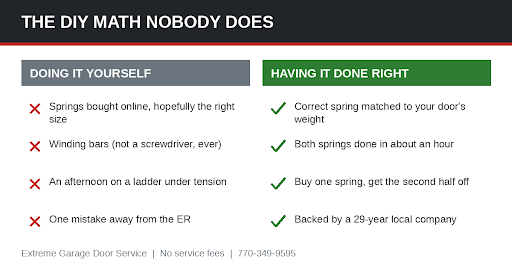
Heard the gunshot sound from the garage? The spring is already broken, and the danger has shifted: the door is now dead weight, and the opener alone can’t safely move it. Don’t cycle the opener repeatedly and don’t lift the door by hand with a broken spring. As an industry leader in garage door spring replacement across Metro Atlanta and Northeast Georgia, Extreme Garage Doors carries the full range of spring sizes on every truck, which is why most broken-spring calls end with the door running the same day. Request service or call 770-349-9595, any hour.
Stay Wound Up About the Right Things
A garage door spring is the one part of your house that’s spring-loaded, always, whether you’re touching it or not. Let it be the one project you hand off. Save the Saturday energy for the sensors and the squeaky rollers, and when the big coil finally gives, call or text 770-349-9595. We’re usually there in 20 to 40 minutes, and the second spring is half off.
FAQs
What’s the best way to handle garage door spring replacement?
Have a professional replace both springs at once, even if only one broke. Both springs have the same wear, and replacing them together means matched lift, one service visit, and a door that runs balanced. At Extreme Garage Doors the second spring is currently half off, and most replacements are finished the same day you call.
How long do garage door springs last?
Standard torsion springs are rated for about 10,000 open-close cycles, which works out to 7 to 10 years for most families. Heavy daily use shortens that. Regular lubrication of the coil helps the spring reach its full rating, and high-cycle springs are available if your garage is the main door to your house.